Tuesday, September 16, 2014

Shikra - Resident Breeder in Sri Lanka.

The shikra (Accipiter badius) is a small bird of prey in the family Accipitridae found widely distributed in Asia and Africa where it is also called the little banded goshawk. The African forms may represent a separate species but have usually been considered as subspecies of the shikra. The shikra is very similar in appearance to other sparrowhawk species including the Chinese goshawk and Eurasian sparrowhawk. They have a sharp two note call and have the typical flap and glide flight. Their calls are imitated by drongos and the common hawk-cuckoo resembles it in plumage.

The shikra is a small raptor (26–30 cm long) and like most other Accipiter hawks, this species has short rounded wings and a narrow and somewhat long tail. Adults are whitish on the underside with fine rufous bars while the upperparts are grey. The lower belly is less barred and the thighs are whitish. Males have a red iris while the females have a less red (yellowish orange) iris and brownish upperparts apart from heavier barring on the underparts. The females are slightly larger. The mesial stripe on the throat is dark but narrow. In flight the male seen from below shows a light wing lining (underwing coverts) and has blackish wing tips. When seen from above the tail bands are faintly marked on the lateral tail feathers and not as strongly marked as in the Eurasian sparrowhawk. The central tail feathers are unbanded and only have a dark terminal band. Juveniles have dark streaks and spots on the upper breast and the wing is narrowly barred while the tail has dark but narrow bands. A post juvenile transitional plumage is found with very strong barring on the contour feathers of the underside. The call is pee-wee, the first note being higher and the second being longer. In flight the calls are shorter and sharper kik-ki ... kik-ki. The Chinese sparrowhawk is somewhat similar in appearance but has swollen bright orange ceres and yellow legs with the wing tips entirely.

Several subspecies are recognized across its range and some of them may be treated as full species. It has been suggested, based on differences in morphology and calls, that the African forms do not belong to this species. Subspecies cenchroides (Severtzov) is larger and paler and found in Turkestan, Afghanistan and eastern Iran. The Indian population dussumieri is resident on the plains and lower hills (up to 1400 m in the Himalayas). The nominate form is found in Sri Lanka and has somewhat darker grey upperparts. The Burmese shikra A. b. poliopsis may represent a distinct species. The population on Car Nicobar Island, earlier treated as a subspecies butleri and that on Katchall Island, obsoletus are now treated as a sub-species within a full species, the Nicobar sparrowhawk (Accipiter butleri). The west African population A. b. sphenurus is migratory while the southern African A. b. polyzonoides is more nomadic in its movements. In Asia onlyA. b. cenchroides is migratory.

The shikra is found in a range of habitats including forests, farmland and urban areas. They are usually seen singly or in pairs. The flight is typical with flaps and glides. During the breeding season pairs will soar on thermals and stoop at each other. Their flight usually draws alarms among smaller birds and squirrels. They feed on rodents (including Meriones hurrianae), squirrels, small birds, small reptiles (mainly lizards but sometimes small snakes) and insects. Small birds usually dive through foliage to avoid a shikra and a Small Blue Kingfisher has been observed diving into water to escape. Babblers have been observed to rally together to drive away a shikra. They will descend to the ground to feast on emerging winged termites, hunt at dusk for small bats (such as Cynopterus sphinx) and in rare instances they may even resort to feed on carrion. In one instance a male was found feeding on a dead chick at the nest. Their calls are mimicked by drongos and this behaviour is thought to aid in stealing food by alarming other birds that the drongos associate with.
The breeding season in India is in summer from March to June. The nest is a platform similar to that of crows lined with grass. Both sexes help build the nest, twigs being carried in their feet. Like crows, they may also make use of metal wires. The usual clutch is 3 to 4 eggs (when eggs are removed they lay replacements and one observer noted that they could lay as many as 7 in a season) which are pale bluish grey stippled on the broad end in black. The incubation period is 18 to 21 days.
Captured @ Rattota - Matale main Road.


Sunday, September 7, 2014

Mongolian Plover - Migrant Bird Specie in Sri Lanka

Mongolian Plovers feed on small invertebrates such as worms, crabs and bivalves. During breeding, they feed on insects. 

Unlike other plovers which use the run-and-peck method, the Mongolian uses the "sewing-machine" feeding action more commonly used by sandpipers. This action aptly describes the way they incessantly probe with their bills for titbits.

Mongolian Plovers prefer to forage on tidal mudflats, particularly in the soft mud between the tides. But they may also forage on drier mudbanks. They are rarely found far inland. They may forage at night. While they feed, Mongolian Plovers are rather scattered, especially at low tide. But they migrate and roost in large numbers, sometimes with other waders.

 Mongolian Plovers breed discontinuously, in areas across east Asia from the Himalayas to North East Siberia, rarely in Alaska.

Like other plovers, Mongolian Plovers nest on the open ground, sometimes besides bushes or large stones. They dig shallow hollows, or use cattle footprints, and line these with pebbles or bits of plants. In the Himalayas, they nest above or beyond the tree-line, at altitudes of up to 5,500m. But in Siberia, on coastal shingle or sand dunes.

2-3 eggs are laid, and both parents incubate (22-24 days) and raise the young. But sometimes only the male raises the young. They fledged at 30-35 days.

ongolian Plovers are powerful travellers. From their northerly breeding grounds, they winter on the coasts and estuaries around the Indian Ocean and South-west Pacific (Africa, India, Sumatra to the Greater Sundas and Australia). There are 5 races which take different migration routes. Those visiting Singapore generally breed in Central or Northeast Asia.

Mongolian Plovers usually winter on muddy and sandy coasts, and occasionally at inland wetlands or on cultivated grounds. On migrations and on wintering grounds, they are found in large numbers, sometimes mixing with Greater Sand Plover (Charadrius leschenaultii), which they closely resemble. In Singapore, they come in groups of about 70. They adopt partial breeding plumage before leaving their wintering grounds.

Captured @ Yala National Park 


Thursday, September 4, 2014

Indian Roller - Resident Breeder in Sri Lanka

The Indian roller (Coracias benghalensis), is a member of the roller family of birds. They are found widely across tropical Asia stretching from Iraq eastward across the Indian Subcontinent to Indochina and are best known for the aerobatic displays of the male during the breeding season. They are very commonly seen perched along roadside trees and wires and are commonly seen in open grassland and scrub forest habitats. It is not migratory, but undertakes some seasonal movements. The largest populations of the species are within India, and Several states in India have chosen it as their state bird.

The Indian roller is a stocky bird about 26–27 cm long and can only be confused within its range with the migratory European roller. The breast is brownish and not blue as in the European Roller. The crown and vent are blue. The primaries are deep purplish blue with a band of pale blue. The tail is sky blue with a terminal band of Prussian blue and the central feathers are dull green. The neck and throat are purplish lilac with white shaft streaks. The bare patch around the eye is ochre in colour. The three forward toes are united at the base. Rollers have a long and compressed bill with a curved upper edge and a hooked tip. The nostril is long and exposed and there are long rictal bristles at the base of the bill.

Three subspecies are usually recognized. The nominate form is found from West Asia (IraqArabia) east across the Indian Subcontinent, and within India north of the Vindhyas mountain ranges. The subspecies indicus is found in peninsular India and Sri Lanka. The southern form has a darker reddish collar on the hind neck which is missing in the nominate form. The race affinis of northeastern Indiaand Southeast Asia (ThailandMyanmarIndochina) is sometimes considered a full species, but within the Indian region, it is seen to intergrade with benghalensis. The form affinis is darker, larger and has a purplish brown and unstreaked face and breast. It has underwing coverts in a deeper shade of blue

The main habitat is cultivation, thin forest and grassland. They are often seen perched on roadside electric wires. he Indian roller is distributed across Asia, from West Asia (Iraq), through the Indian Subcontinent (including Sri Lanka and the islands of Lakshadweep and Maldive Islands) into Southeast Asia.

These birds are usually seen perched on prominent bare trees or wires. They descend to the ground to capture their prey which may include insects, arachnids, small reptiles (including Calotes versicolor and small snakes and amphibians. Fires attract them and they will also follow tractors for disturbed invertebrates. In agricultural habitats in southern India, they have been found at densities of about 50 birds per km2. They perch mainly on 3—10 metre high perches and feed mostly on ground insects. Nearly 50% of their prey are beetles and 25% made up by grasshoppers and crickets.The breeding season is March to June.

Captured @ Wasgamuwa National Park.


Sunday, August 31, 2014

Common redshank - Migrant bird specie in Sri Lanka

The common redshank or simply redshank (Tringa totanus) is an Eurasian wader in the large family Scolopacidae..

Common redshanks in breeding plumage are a marbled brown color, slightly lighter below. In winter plumage they become somewhat lighter-toned and less patterned, being rather plain greyish-brown above and whitish below. They have red legs and a black-tipped red bill, and show white up the back and on the wings in flight..

It is a widespread breeding bird across temperate Eurasia. It is a migratory species, wintering on coasts around the Mediterranean, on the Atlantic coast of Europe from Great Britain southwards, and in South Asia. They are uncommon vagrants outside these areas; on Palau in Micronesia for example, the species was recorded in the mid-1970s and in 2000.

They are wary and noisy birds which will alert everything else with their loud piping call. Like most waders, they feed on small invertebrates. Redshanks will nest in any wetland, from damp meadows to saltmarsh, often at high densities. They lay 3-5 eggs.
The common redshank is one of the species to which the Agreement on the Conservation of African-Eurasian Migratory Waterbirds(AEWA) applies.
It is widely distributed and quite plentiful in some regions, and thus not considered a threatened species by the IUCN.

Captured in Kumana National Park.


Tuesday, August 12, 2014

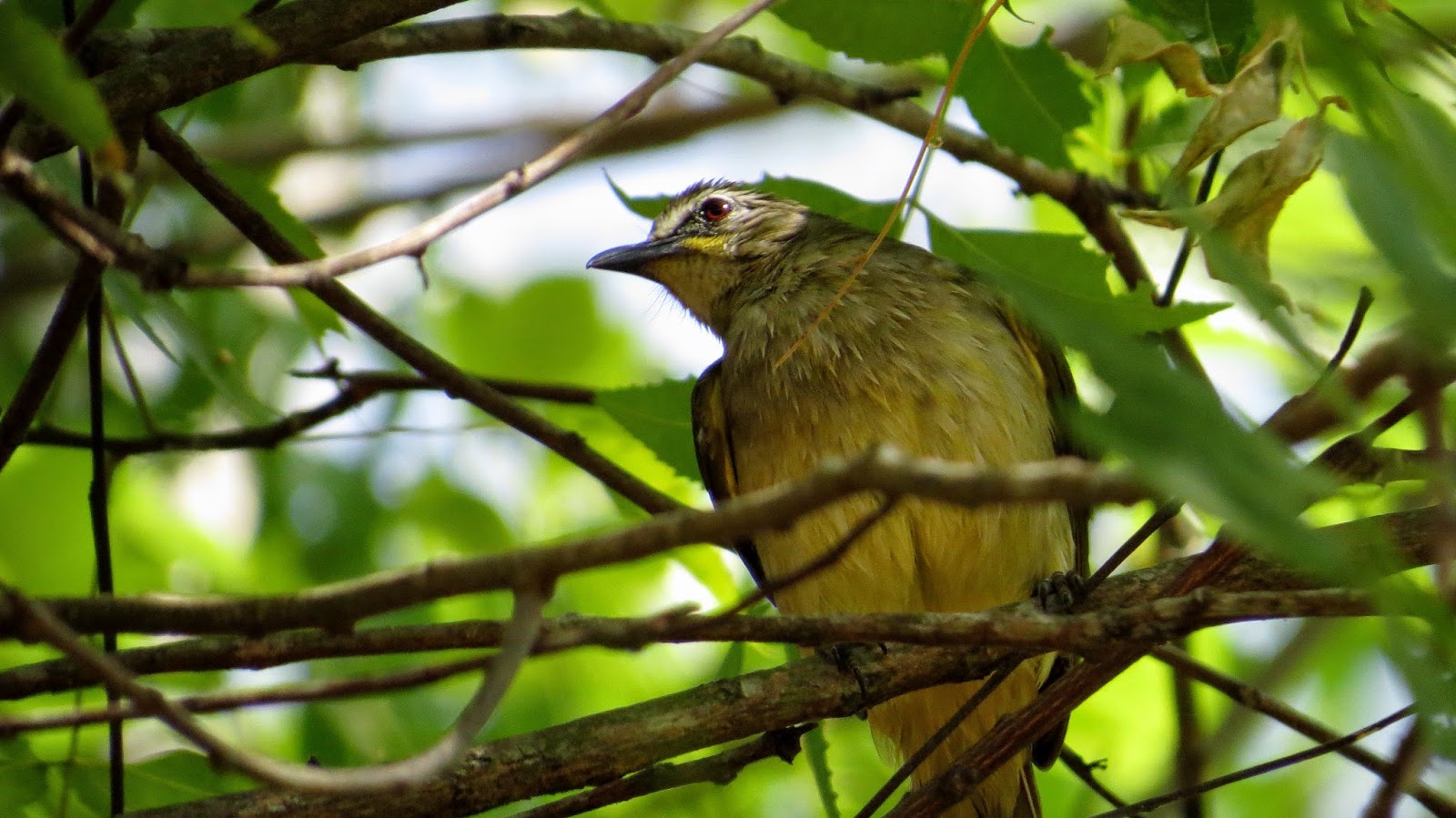
White-browed bulbul - Resident Breeder in Sri Lanka - Also Endemic to Indian Sub Continent

The White-browed Bulbul ( Pycnonotus luteolus) is a member of the bulbul family of passerine birds. It is a resident breeder in Sri Lanka and peninsular India. Largely olive coloured above with whitish underparts, it has a pale supercilium and a yellow vent. They are found in dense scrub habitats, where they skulk within vegetation and can be difficult to see although their loud and distinct burst of calls is distinctive.

The White-browed Bulbul is about 20 cm (7 inches) long, with a moderately long (8 cm) tail. It has olive-grey upperparts and whitish underparts. This species is identifiable by the white supercilium, white crescent below the eye, and dark eye stripe and moustachial stripe. The vent is yellowish and there is some yellow on the chin and moustache. The throat is however largely whitish unlike in the similar looking and sounding Yellow-throated Bulbul which is found in rockier habitats. Three or four hair-like filoplumes are present on the nape. Sexes are similar in plumage. It is usually detected by the burst of song that it produces from the top of a bush and often dives into the bush becoming difficult to see. The song is a rich, spluttering warble and the bird is more often heard than seen. The nominate form is from southern India while insulae from Sri Lanka is slightly darker and has a shorter wing. Known as à¶¶ැම à·ƒුදු à¶šොà¶±්ඩයා in Sinhala.

This species is endemic to southern India and Sri Lanka. The northern boundary is along Gujarat, Madhya Pradesh and western West Bengal (near Midnapur). It is found in dry open scrub country mainly on the plains and also occurs in gardens and woodlands with dense shrubbery.

White-browed Bulbuls are usually seen singly or in pairs. They forage within bushes for fruit, nectar and insects. The breeding season is spread out from March to September and may possibly breed twice a year. Peaks in breeding occur in February and again in September. The dry season of May to July appears to be avoided for breeding in the Point Calimere region. They build a nest, a loose cup made of twigs, cobwebs and hair placed low in a thick bush and usually on the periphery. Two eggs form the typical clutch.Individuals may live for more than 11 years.

Captured in Wasgamuwa National Park


Monday, August 11, 2014

Little ringed plover - Migrant Bird Specie in Sri Lanka

The little ringed plover (Charadrius dubius) is a small ploverPlovers are a widely distributed group of wading birds belonging to the subfamily Charadriinae. There are about 66 species[1] in the subfamily, most of them called "plover" or "dotterel". The closely related lapwing subfamily, Vanellinae, comprises another 20-odd species. 


Adults have a grey-brown back and wings, a white belly, and a white breast with one black neckband. They have a brown cap, a white forehead, a black mask around the eyes with white above and a short dark bill. The legs are flesh-coloured and the toes are all webbed.
MENU
0:00
Call of little ringed plover

Problems playing this file? See media help.
This species differs from the larger ringed plover in leg colour, the head pattern, and the presence of a clear yellow eye-ring.
Their breeding habitat is open gravel areas near freshwater, including gravel pits, islands and river edges in Europe and western Asia. They nest on the ground on stones with little or no plant growth. Both male and female take turn to incubate the eggs.
They are migratory and winter in Africa. These birds forage for food on muddy areas, usually by sight. They eat insects and worms.
The little ringed plover is one of the species to which the Agreement on the Conservation of African-Eurasian Migratory Waterbirds (AEWA) applies.
Captured @ Wasgamuwa National Park.


Monday, August 4, 2014

Asian openbill - Resident breeder in Sri Lanka

The Asian openbill or Asian openbill stork (Anastomus oscitans) is a large wading bird in the stork family Ciconiidae. This distinctive stork is found mainly in the Indian subcontinent and Southeast Asia. It is greyish white with glossy black wings and tail and the adults have a gap between the arched upper mandible and recurved lower mandible. Young birds are born without this gap which is thought to be an adaptation that aids in the handling of snails, their main prey. Although resident within their range, they make long distance movements in response to weather and food availability.

The Asian openbill stork is predominantly greyish white with glossy black wings and tail that have a green or purple sheen. The name is derived from the distinctive gap formed between the recurved lower and arched upper mandible of the beak in adult birds. Young birds do not have this gap. The cutting edges of the mandible have a fine brush like structure that is thought to give them better grip on the shells of snails.

The mantle is black and the bill is horn-grey. At a distance, they can appear somewhat like a white stork or Oriental stork. The short legs are pinkish to grey, reddish prior to breeding. Non-breeding birds have a smoky grey back instead of white. Young birds are brownish-grey and have a brownish mantle. Like other storks, the Asian openbill is a broad-winged soaring bird, which relies on moving between thermals of hot air for sustained flight. They are usually found in flocks but single birds are not uncommon. Like all storks, it flies with its neck outstretched. It is relatively small for a stork and stands at 68 cm height (81 cm long).

The usual foraging habitats are inland wetlands and are only rarely seen along river banks and tidal flats. Birds may move widely in response to habitat conditions. Young birds also disperse widely after fledging. Individuals ringed at Bharatpur in India have been recovered 800 km east and a bird ringed in Thailand has been recovered 1500 km west in Bangladesh. Storks are regularly disoriented by lighthouses along the southeast coast of India on overcast nights between August and September.The species is very rare in the Sind and Punjab regions of Pakistan, but widespread and common in India, Sri Lanka, Burma and Thailand.

The Asian openbill feeds mainly on large molluscs, especially Pila species, and they separate the shell from the body of the snail using the tip of the beak. The tip of the lower mandible of the beak is often twisted to the right. This tip is inserted into the opening of the snail and the body is extracted with the bill still under water. Jerdon noted that they were able to capture snails even when blindfolded.

The breeding season is after the rains, during July to September in northern India and November to March in southern India and Sri Lanka. They may skip breeding in drought years. The Asian openbill breeds colonially, building a rough platform of sticks often on half-submerged trees (often BarringtoniaAvicennia and Acacia species), typically laying two to four eggs. The nesting trees are shared with those ofegretscormorants and darters. Nesting colonies are sometimes in highly disturbed areas such as inside villages. The nests are close to each other leading to considerable jostling among neighbours. Both parents take turns in incubation, the eggs hatching after about 25 days. The chicks emerge with cream coloured down and are shaded by the loosely outspread and drooped wings of a parent.

Captured in Kumana National Park